The Hierarchy
of Hustle
™
The No Bollocks™ Roadmap from Zero to Generational Wealth
By Matt Haycox — Built from 100+ businesses, two bankruptcies, and the climb back to the top. Twice.
How to Use This Framework
Most business advice is written for people at one specific stage. Startup advice is useless to someone running a £5M company. Scaling advice is irrelevant to someone who has not made their first sale. And wealth-building advice is meaningless to someone who cannot make payroll. The result is that entrepreneurs spend half their time consuming advice that does not apply to them, and the other half wondering why it is not working.
The Hierarchy of Hustle solves this problem. It is a five-level framework that maps the entire entrepreneurial journey — from your first pound of revenue to generational wealth — and tells you exactly what to focus on at each level. Not what sounds good. Not what the gurus are selling this week. What actually matters, right now, at your specific stage.
The framework is called a "hierarchy" because it works like Maslow's hierarchy of needs. Maybe you remember learning about it when you were in school. You cannot focus on Level 3 until you have mastered Levels 1 and 2. You cannot build wealth (Level 5) until you have built systems (Level 4). Trying to skip levels is the single most common reason entrepreneurs stall, burn out, or fail. They are working on the wrong things for their stage.
I have built, bought, sold, and invested in over 100 businesses. I have been at every level of this hierarchy — including back at Level 1 after losing everything. This guide is the distillation of what I have learned from climbing the hierarchy, falling down it, and climbing it again. Every level is written from experience, not theory.
Your Instructions
Read the entire framework once to understand the full journey. Then identify your current level, and focus exclusively on mastering it before moving to the next. The hierarchy is patient. It will wait for you. But it will not let you skip ahead.
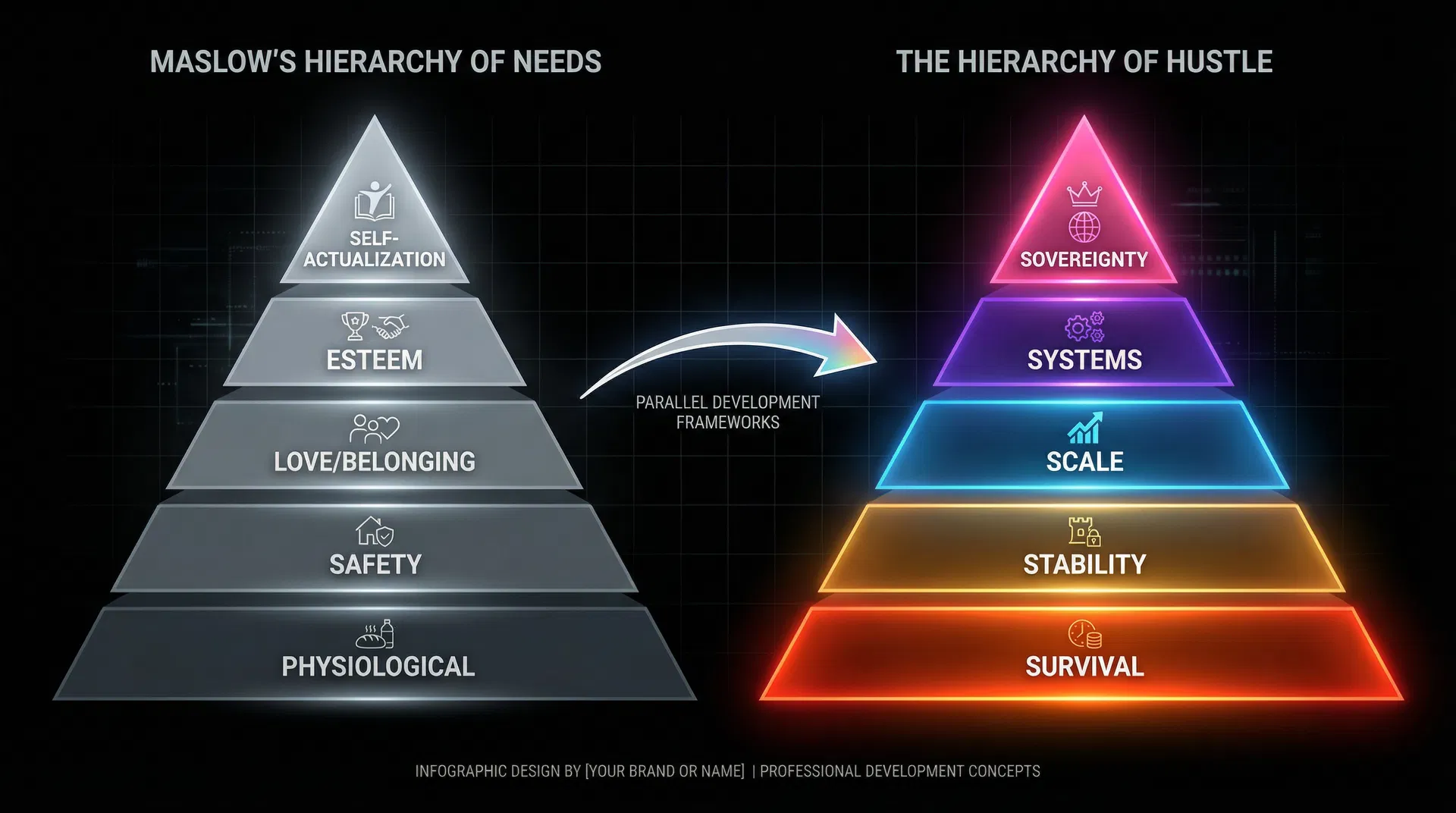
Maslow mapped human needs. Matt mapped the entrepreneurial journey.
Why Most Entrepreneurs Stay Stuck
The entrepreneurial world is full of people who are busy but not progressing. They work 60-hour weeks but their business has not grown in two years. They read every book, attend every conference, and consume every podcast, but nothing changes. They are stuck — and they do not understand why.
The reason is almost always the same: they are working on the wrong level.
The Misdiagnosis Table
Why entrepreneurs stay stuck — and what's really going on
| Symptom | What They Think the Problem Is | What the Problem Actually Is |
|---|---|---|
| "I cannot seem to grow past £500K" | "I need better marketing" | They have not built systems (Level 4) and are still doing everything themselves (Level 2) |
| "I am working 80 hours a week and burning out" | "I need to hire more people" | They have not achieved Stability (Level 2) and are still in Survival mode (Level 1) |
| "I have a great team but the business plateaus every year" | "I need a new strategy" | They have not built Scale (Level 3) — the business depends on them personally |
| "I make good money but I have no wealth" | "I need to invest better" | They have not built Systems (Level 4) — all the money goes back into the business |
| "I have built a successful business but I feel trapped" | "I need a holiday" | They have never transitioned from operator to owner — the business owns them, not the other way around |
The Hierarchy of Hustle gives you the diagnostic tool to identify your actual level and the specific playbook to master it.
The Five Levels
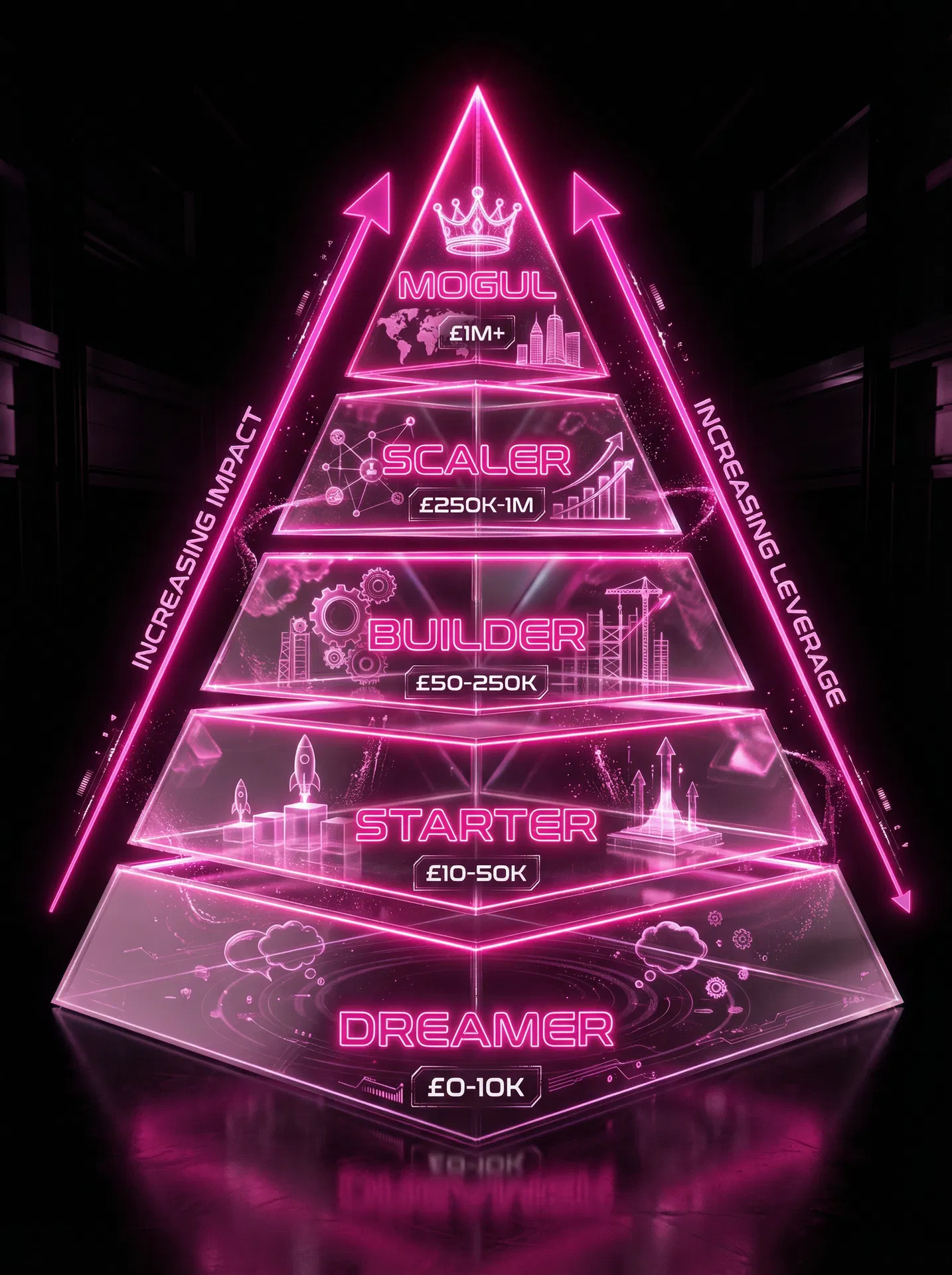
THE HIERARCHY OF HUSTLE — FIVE LEVELS OF BUSINESS MASTERY
| Level | Name | Core Question | Revenue Range | Key Metric |
|---|---|---|---|---|
| 1 | SURVIVAL | "Can I make money?" | £0–£100K | First £1 of revenue |
| 2 | STABILITY | "Can I make money consistently?" | £100K–£500K | Consistent monthly cash flow |
| 3 | SCALE | "Can the business grow beyond me?" | £500K–£5M | Revenue per employee |
| 4 | SYSTEMS | "Can the business run without me?" | £5M–£20M+ | Owner hours per week |
| 5 | SOVEREIGNTY | "Can my wealth work harder than I do?" | £20M+ | Passive income vs active income |
Each level has a specific set of challenges, a specific set of skills to develop, and a specific set of mistakes to avoid. The revenue ranges are indicative, not absolute — some businesses reach Level 3 challenges at £300K, others not until £1M. The levels are defined by the nature of the challenges you face, not by a specific number.
SURVIVAL
"Can I make money?"

One desk. One laptop. One chance.
What This Level Is About
Level 1 is the most primal level of entrepreneurship. It is about one thing and one thing only: proving that someone will pay you money for something. Not building a brand. Not creating a culture. Not optimising your funnel. Making a sale. Getting paid. Proving that the business concept is not just an idea in your head but a transaction that someone is willing to complete with their wallet.
Most entrepreneurs spend far too long at Level 1 because they focus on the wrong things. They build websites before they have customers. They design logos before they have revenue. They write business plans before they have made a single sale. All of these activities feel productive, but they are displacement activities — ways of avoiding the terrifying, ego-threatening act of asking someone to give you money.
Level 1 is about confronting that fear and getting past it. Everything else can wait.
The Only Thing That Matters: The First Sale
The first sale is the most important moment in any business. Not because of the revenue — the first sale is usually small. But because of what it proves: that a real person, with real money, made a real decision to exchange that money for what you are offering. That is validation. That is proof of concept. That is the foundation upon which everything else is built.
How to Make the First Sale
| Step | What to Do | Common Mistake |
|---|---|---|
| 1. Define the offer | Describe exactly what you are selling, who it is for, and what outcome it delivers — in one sentence | Making the offer too broad, too vague, or too complicated |
| 2. Identify 10 potential buyers | Name 10 specific people or companies who have the problem your offer solves and the money to pay for it | Targeting "everyone" instead of specific, reachable individuals |
| 3. Reach out personally | Contact each of the 10 directly — by phone, email, LinkedIn message, or in person. Not through ads. Not through content. Directly. | Hiding behind marketing instead of having direct conversations |
| 4. Have the conversation | Ask about their problem. Listen. Explain how you solve it. Ask if they would like to proceed. | Talking too much about yourself and not enough about their problem |
| 5. Close the sale | Ask for the money. Agree on terms. Send the invoice. Collect payment. | Being afraid to ask for money, or underpricing out of insecurity |
THE RULE: You are not allowed to spend money on anything — a website, a logo, business cards, advertising, software — until you have made your first sale. The first sale proves the concept. Everything before the first sale is speculation.
The Survival Mindset
Level 1 requires a specific mindset that is different from every other level. It is not strategic. It is not sophisticated. It is raw, urgent, and relentless.
Revenue solves everything
At Level 1, every problem is a revenue problem. Not enough customers? That is a revenue problem. Cannot afford to hire? Revenue problem. Cannot invest in marketing? Revenue problem. Focus on revenue.
Speed beats perfection
The product does not need to be perfect. The website does not need to be beautiful. The pitch does not need to be polished. It needs to be good enough to sell. Ship it, sell it, improve it later.
Say yes to everything (almost)
At Level 1, you cannot afford to be selective. Take the meeting. Do the project. Accept the terms. You are building a portfolio of results and relationships. Selectivity is a luxury for Level 3.
Track every pound
Know exactly how much money is coming in, how much is going out, and how much is left. Use a spreadsheet. Check it daily. Cash awareness at Level 1 is the habit that prevents crises at every subsequent level.
Sell before you build
Do not build the product, then try to sell it. Sell the concept, then build the product. Pre-selling validates demand and funds development simultaneously.
The Survival Toolkit
At Level 1, you need very few tools. The temptation is to sign up for every SaaS product, every platform, every tool that promises to make your life easier. Resist this temptation. Every tool costs money (even "free" tools cost time), and at Level 1, your resources are too scarce to waste on anything that does not directly generate revenue.
The Level 1 Toolkit
| Tool | Purpose | Cost |
|---|---|---|
| A phone | Making calls, sending messages, having conversations | You already have one |
| A spreadsheet (Google Sheets) | Tracking finances, managing contacts, planning activities | Free |
| A bank account | Receiving payments, managing cash | Free or minimal |
| A simple invoicing tool | Sending professional invoices and collecting payment | Free tier available (Wave, PayPal) |
| A LinkedIn profile | Finding prospects, building credibility, sharing content | Free |
| A notebook | Writing down ideas, plans, and commitments | £3 (or use some scrap paper!) |
That is it. You do not need a CRM. You do not need a project management tool. You do not need a website. You do not need a logo. You need customers and revenue. Everything else is a distraction at Level 1.
When to Move to Level 2
| Signal | What It Means |
|---|---|
| You have made at least 10 sales to at least 5 different customers | The business model is validated — people will pay for what you offer |
| You have generated at least £5,000–£10,000 in revenue | You have proven you can generate meaningful income |
| You can describe your ideal customer and your core offer clearly | You have moved from "trying things" to "knowing what works" |
| You are turning away work or struggling to keep up with demand | Demand exceeds your personal capacity — a good problem |
| You have been doing this for at least 3–6 months | You have sustained effort long enough to prove this is not a fluke |
Level 1 Checklist
Defined a clear, specific offer in one sentence
Identified 10 potential buyers by name
Contacted all 10 directly and had conversations
Made the first sale and collected payment
Made at least 10 sales to at least 5 different customers
Generated at least £5,000 in total revenue
Established a daily habit of tracking income and expenses
Resisted the urge to spend money on non-revenue-generating activities
SCALE
"Can the business grow beyond me?"

From solo operator to organisation builder.
What This Level Is About
Level 2 gave you a stable, profitable business. Level 3 is about turning that business into something that can grow without being limited by your personal capacity. This is the most transformative — and most difficult — transition in the entire hierarchy. Because at Levels 1 and 2, the business was you. Your skills, your relationships, your effort. At Level 3, the business must become bigger than you. It must be able to serve more customers, deliver more value, and generate more revenue than you could ever produce alone.
This requires three things that most founders find deeply uncomfortable: hiring people, trusting people, and letting go of control.
The founder who cannot make this transition will have a business that plateaus at whatever level their personal capacity allows — typically £300K–£500K. They will work harder and harder for the same result, and eventually burn out. The founder who makes this transition will build a business that grows exponentially, because every person they add multiplies the capacity of the organisation.
The Scaling Mindset Shift
The shift from Level 2 to Level 3 is not a business change — it is an identity change. At Levels 1 and 2, your identity was "the person who does the work." At Level 3, your identity must become "the person who builds the team that does the work." This is a fundamentally different job, and it requires fundamentally different skills.
The Identity Transition
| Level 2 Identity | Level 3 Identity |
|---|---|
| "I am the best salesperson in the business" | "I build and train salespeople who are collectively better than me" |
| "I deliver the best work" | "I define the standard and build systems that ensure everyone delivers to it" |
| "Customers want to work with me personally" | "Customers want to work with my company because of the consistent quality we deliver" |
| "Nobody can do it as well as I can" | "My job is to make other people as good as I was — and then better" |
| "I make all the decisions" | "I make the strategic decisions and empower my team to make the operational ones" |
This transition is painful. It means accepting that other people will do things differently from how you would do them. Sometimes worse. Sometimes — and this is the part that really stings — better. But the alternative is a business that can never grow beyond your personal limitations, and that is not a business. That is a job with extra stress.
Building the Team
At Level 3, hiring is no longer about filling gaps — it is about building an organisation. The decisions you make about who to hire, in what order, and how to structure the team will determine whether the business scales smoothly or collapses under its own weight.
The Hiring Sequence
The order matters enormously. Hire wrong and you'll have expensive people sitting idle.
| Hire # | Role | Why This Order |
|---|---|---|
| 1 | Delivery / Operations | Free yourself from delivery so you can focus on sales and strategy. This is usually the first bottleneck. |
| 2 | Administrative / Financial | Free yourself from admin, invoicing, bookkeeping, and compliance. These tasks consume more time than you realise. |
| 3 | Sales / Business Development | Once delivery capacity exists, you need someone generating new business so you are not the only rainmaker. |
| 4 | Marketing / Content | Build a lead generation engine that feeds the sales function with qualified prospects. |
| 5 | Management / Team Lead | Once you have 5–8 people, you need someone managing the day-to-day so you can focus on strategy and growth. |
The Hiring Framework: The 5 C's
| Criterion | What to Assess | How to Assess It |
|---|---|---|
| Capability | Can they do the job at the level required, today? | Skills test, portfolio review, trial project |
| Culture | Do they share the values and work ethic of the team? | Behavioural interview questions, team interaction, reference checks |
| Coachability | Are they willing to learn, accept feedback, and improve? | Ask about a time they received critical feedback and what they did with it |
| Commitment | Are they genuinely invested in the mission, or just looking for a pay cheque? | Ask why they want this specific role at this specific company |
| Cost | Can you afford them without jeopardising cash flow? | Salary benchmarking, total cost calculation (salary + NI + benefits + equipment) |
THE RULE: Never hire based on potential alone. At Level 3, you need people who can perform from day one. You do not have the management infrastructure to develop raw talent yet — that comes at Level 4. Hire people who have done the job before, in a similar environment, and can hit the ground running.
Building the Machine
A team without systems is just a group of people. Systems are what turn a group of people into a machine — a machine that produces consistent, predictable, high-quality output regardless of who is operating it.
The Core Systems for Scale
| System | What It Does | Why It Matters at Level 3 |
|---|---|---|
| Standard Operating Procedures (SOPs) | Documents how every repeatable process is performed, step by step | Ensures consistency when multiple people are doing the same work |
| CRM (Customer Relationship Management) | Tracks every customer interaction, deal, and relationship in one place | Prevents leads from falling through the cracks and enables sales management |
| Project Management | Tracks deliverables, deadlines, responsibilities, and progress | Ensures nothing is missed and everyone knows what they are responsible for |
| KPI Dashboard | Tracks the key metrics that drive the business — revenue, pipeline, delivery, satisfaction | Enables management by numbers instead of management by gut feeling |
| Meeting Cadence | A structured schedule of team meetings — daily standups, weekly reviews, monthly strategy | Keeps everyone aligned, surfaces problems early, and maintains accountability |
The SOP Framework
For every process in the business, create an SOP that includes:
| Element | What to Include |
|---|---|
| Purpose | Why this process exists and what outcome it produces |
| Trigger | What initiates the process (e.g., a new customer signs up, an invoice is overdue) |
| Steps | The exact steps to follow, in order, with enough detail that someone new could follow them |
| Tools | What software, templates, or resources are needed |
| Quality standard | What "good" looks like — the minimum acceptable standard for the output |
| Owner | Who is responsible for this process |
| Exceptions | What to do when the standard process does not apply |
THE RULE: If a process happens more than twice, it needs an SOP. If it does not have an SOP, it will be done differently every time, by every person, with unpredictable results.
The Delegation Framework
Delegation is the skill that separates Level 2 founders from Level 3 founders. Most founders are terrible at it — not because they do not want to delegate, but because they do not know how. They either delegate too little (and remain the bottleneck) or delegate too much too fast (and quality collapses).
The Delegation Ladder
| Level | What You Delegate | What You Retain |
|---|---|---|
| Level 1: Tasks | Specific, well-defined tasks with clear instructions | Decision-making, quality control, and oversight |
| Level 2: Functions | Entire functions (e.g., "manage all invoicing and collections") | Setting standards, reviewing results, and course-correcting |
| Level 3: Outcomes | Outcomes (e.g., "ensure we collect 95% of invoices within 30 days") | Defining the outcome and holding the person accountable |
| Level 4: Authority | Full authority over a domain (e.g., "own the finance function") | Strategic direction and exception handling |
Start at Level 1 and progress as trust and competence develop. Jumping straight to Level 4 with a new hire is a recipe for disaster. Building through the levels is how you develop leaders.
When to Move to Level 4
| Signal | What It Means |
|---|---|
| The business has 8–15+ employees and is growing | You have a real team, not just a few helpers |
| Revenue is growing year-over-year without you personally selling or delivering | The machine is working |
| You have at least one person who can run the business for 2 weeks while you are away | You are no longer the single point of failure |
| You spend more time on strategy and leadership than on operations | Your role has shifted from operator to leader |
| The business has documented SOPs for all core processes | The business runs on systems, not on you |
Level 3 Checklist
Made the mindset shift from "doer" to "builder"
Hired at least 3–5 people following the hiring sequence
Implemented a CRM and project management system
Created SOPs for all core business processes
Established a meeting cadence (daily, weekly, monthly)
Built a KPI dashboard that the team reviews weekly
Delegated at least one major function to a team member
Taken at least one week off without the business suffering
Revenue is growing without your direct involvement in sales or delivery
Identified and begun developing at least one future leader within the team
SOVEREIGNTY
"Can my wealth work harder than I do?"

Freedom is not retirement. It is choosing what to build next.
What This Level Is About
Level 5 is the summit of the hierarchy. It is the level where you stop trading time for money — permanently. Not because you stop working, but because your wealth generates more income than your labour ever could. Your businesses run without you. Your investments compound while you sleep. Your time is spent on what you choose, not what you must.
Sovereignty is not retirement. Most entrepreneurs who reach Level 5 are more active than ever — but they are active by choice, pursuing the projects, investments, and causes that excite them, not the ones that pay the bills. The bills are paid. The mortgage is gone. The children's education is funded. The future is secured. What remains is the freedom to deploy your time, energy, and capital toward whatever creates the most meaning.
This is the level that separates the wealthy from the rich. Rich is a high income. Wealthy is a high net worth that generates passive income. Rich is fragile — it depends on your continued effort. Wealthy is antifragile — it grows whether you work or not.
The Wealth Architecture
At Level 5, your wealth is not sitting in a bank account. It is deployed across a portfolio of assets that generate income, appreciate in value, and compound over time. The structure of this portfolio is your Wealth Architecture — and designing it correctly is the difference between wealth that lasts a generation and wealth that lasts a lifetime.
The Wealth Architecture Framework
| Asset Class | Purpose | Target Allocation | Expected Return | Liquidity |
|---|---|---|---|---|
| Operating businesses | Active income and growth | 20–40% | 15–30%+ | Low (illiquid) |
| Property | Rental income and capital appreciation | 20–30% | 8–15% | Low-Medium |
| Public equities (stocks, ETFs) | Growth and dividend income | 15–25% | 7–12% | High |
| Private equity / Angel investments | High-growth returns | 10–20% | 20–50%+ (or total loss) | Very Low |
| Cash and fixed income | Liquidity and stability | 5–15% | 3–5% | Very High |
| Alternative assets (art, crypto, commodities) | Diversification and asymmetric upside | 0–10% | Variable | Variable |
Never have more than 40% in any single asset class
Concentration creates fragility. Diversification creates resilience.
Always maintain 12+ months of living expenses in cash
Ensures you never have to sell assets at a bad time to fund your lifestyle.
Rebalance annually
Markets move. Your allocation will drift. Annual rebalancing keeps it aligned with your strategy.
Separate "wealth preservation" from "wealth creation"
The money that funds your lifestyle should be in low-risk, income-generating assets. The money you are willing to lose should be in high-risk, high-return opportunities. Never confuse the two.
The Income Streams
At Level 5, your income should come from multiple independent sources. This is not about maximising income — it is about making income resilient. If one source fails, the others continue.
The Income Stream Matrix
| Stream | Source | Effort Required | Resilience |
|---|---|---|---|
| Business dividends | Profits from operating businesses you own but do not run | Minimal (board-level oversight) | Medium (depends on business performance) |
| Rental income | Income from property portfolio | Low (managed by property manager) | High (people always need somewhere to live) |
| Investment returns | Dividends, interest, and capital gains from public and private investments | Minimal (managed by financial advisor) | Medium-High (diversified portfolio) |
| Royalties / Licensing | Income from intellectual property, courses, books, frameworks | Zero (once created) | Medium (depends on continued relevance) |
| Advisory / Board fees | Income from sitting on boards or advising companies | Low (a few hours per month per company) | Medium (depends on your reputation and network) |
| Speaking fees | Income from keynote speeches and appearances | Variable (depends on how much you want to do) | Low (depends on continued demand) |
THE TARGET: At Level 5, your passive and semi-passive income (streams that require less than 5 hours per week of your time) should exceed your total living expenses by at least 2x. This creates a margin of safety that ensures your lifestyle is funded regardless of what happens to any single income stream.
The Investment Philosophy
At Level 5, you are no longer just an entrepreneur — you are an investor. And investing requires a different mindset from operating. The operator asks "how do I make this work?" The investor asks "what is the risk-adjusted return, and does it fit my portfolio?"
The Level 5 Investment Framework
| Principle | What It Means | How to Apply It |
|---|---|---|
| Invest in what you understand | Only invest in businesses, sectors, and asset classes where you have genuine expertise or can access expert guidance | If you cannot explain the investment thesis in 2 minutes, you do not understand it well enough |
| Diversify across time, not just assets | Do not invest everything at once. Spread investments over months and years to reduce timing risk | Invest a fixed amount monthly (pound-cost averaging) rather than making large lump-sum investments |
| Separate conviction bets from portfolio bets | Most of your wealth should be in diversified, low-cost investments. A small portion can go into high-conviction, high-risk opportunities. | 80% in diversified portfolio, 20% in conviction bets |
| Always have an exit plan | Before you invest, know how and when you will exit. What is the target return? What is the timeline? What triggers a sale? | Write down the exit criteria before making the investment |
| Never invest money you cannot afford to lose | High-return investments carry high risk. Only invest money that, if lost entirely, would not affect your lifestyle or financial security. | The "sleep test" — if losing this money would keep you awake at night, do not invest it |
Tax Efficiency & Wealth Structuring
At Level 5, the structure of your wealth matters as much as the amount. The difference between a well-structured and a poorly structured portfolio can be hundreds of thousands of pounds per year in unnecessary tax.
The Key Structures
| Structure | Purpose | Benefit |
|---|---|---|
| Holding company | Owns shares in your operating businesses and investments | Dividends received from subsidiaries are often tax-exempt; capital gains can be reinvested without personal tax |
| Family Investment Company (FIC) | A company owned by family members that holds investments | Enables wealth transfer to the next generation while retaining control; potential IHT benefits |
| Pension (SIPP/SSAS) | Tax-advantaged retirement savings | Contributions are tax-deductible; growth is tax-free; 25% can be withdrawn tax-free at retirement |
| ISA | Tax-free savings and investment wrapper | All growth and income is tax-free (up to annual limits) |
| Trusts | Holds assets for the benefit of specified beneficiaries | Can reduce inheritance tax, protect assets, and provide for future generations |
| Offshore structures | Holds international assets in tax-efficient jurisdictions | Must be fully compliant with UK tax law; seek specialist advice |
THE RULE: Tax structuring is complex and the rules change frequently. Always work with a specialist tax advisor and a wealth structuring lawyer. The cost of professional advice is a fraction of the tax savings they will generate.
Legacy & Generational Wealth
The final dimension of Level 5 is legacy — ensuring that the wealth you have built outlasts you and serves the people and causes you care about. This is not just about money. It is about values, knowledge, and the systems that preserve both.
The Legacy Framework
| Dimension | What to Build | How to Build It |
|---|---|---|
| Financial legacy | Wealth structures that transfer assets to the next generation efficiently | Family Investment Company, trusts, life insurance, estate planning |
| Knowledge legacy | The wisdom, principles, and lessons you have learned, documented for future generations | A personal "operating manual" — a document that captures your investment philosophy, business principles, and life lessons |
| Values legacy | The values and principles that drove your success, transmitted to your children and community | Family governance structures, mentorship, philanthropy, leading by example |
| Impact legacy | The positive impact you create beyond your own wealth — in your community, your industry, or the world | Charitable giving, foundation creation, social enterprise investment, mentorship programmes |
The Generational Wealth Paradox
The first generation makes it, the second generation maintains it, the third generation loses it.
This pattern is so common that it has equivalents in almost every culture. The reason is simple: the skills that create wealth (hustle, risk-taking, resilience) are different from the skills that preserve wealth (discipline, stewardship, financial literacy), and these skills are not automatically inherited.
Breaking the Paradox
| Strategy | How It Works |
|---|---|
| Financial education | Teach your children about money, investing, and business from a young age. Not in theory — in practice. Give them small amounts to invest. Let them make mistakes with small stakes. |
| Earned involvement | Do not simply hand over wealth. Require the next generation to earn their involvement — through education, work experience, or demonstrated competence. |
| Governance structures | Create a family constitution that defines how wealth is managed, how decisions are made, and what values shape the family's financial behaviour. |
| Professional management | Appoint professional trustees, investment managers, and advisors who can provide objective guidance and prevent emotional decision-making. |
| Gradual transfer | Transfer wealth gradually over time, not all at once. This allows the next generation to develop competence incrementally. |
Level 5 Checklist
Designed a Wealth Architecture with appropriate diversification
Built at least 3 independent income streams
Passive/semi-passive income exceeds living expenses by 2x+
Implemented tax-efficient structures (holding company, FIC, pension, trusts)
Engaged a specialist tax advisor and wealth structuring lawyer
Created a personal "operating manual" documenting your principles and lessons
Begun financial education for the next generation
Established a governance structure for family wealth
Identified and begun funding your impact legacy (philanthropy, mentorship, social enterprise)
Achieved genuine freedom — working on what you choose, not what you must
Putting It All Together
| Level | Name | Core Question | Key Milestone | Typical Timeline |
|---|---|---|---|---|
| 1 | SURVIVAL | Can I make money? | First 10 sales | 3–12 months |
| 2 | STABILITY | Can I make money consistently? | 6 months of consistent revenue | 12–24 months |
| 3 | SCALE | Can the business grow beyond me? | Team of 8–15, revenue growing without founder selling/delivering | 2–5 years |
| 4 | SYSTEMS | Can the business run without me? | Passed the "Hit by a Bus" test | 5–10 years |
| 5 | SOVEREIGNTY | Can my wealth work harder than I do? | Passive income exceeds 2x living expenses | 10–20+ years |

HOW YOUR TIME ALLOCATION SHIFTS AS YOU CLIMB THE HIERARCHY

KEY REVENUE MILESTONES AND TIMELINES AT EACH LEVEL
Total timeline from Level 1 to Level 5: 10–20+ years. There are no shortcuts. There are no hacks. There is only the work — done consistently, done well, done with discipline and patience. Anyone who tells you otherwise is selling something.
The Hierarchy of Hustle Manifesto
Know your level.
The most common reason entrepreneurs stall is that they are working on the wrong level. Diagnose your level honestly. Focus on mastering it. Do not skip ahead.
Revenue solves everything at Level 1.
Do not build a brand. Do not optimise a funnel. Do not create content. Make a sale. Get paid. Everything else comes after.
Consistency is the bridge from Level 1 to Level 2.
Anyone can have a good month. The question is whether you can have 12 good months in a row. Consistency is not glamorous, but it is the foundation of everything.
You are the bottleneck at Level 3.
The business cannot grow beyond your personal capacity until you learn to hire, trust, and delegate. This is the hardest transition in the hierarchy, and the most important.
Systems beat talent at Level 4.
A great system with average people will outperform a bad system with great people every time. Build the systems. Document the processes. Make the business run on structure, not on heroics.
Wealth is a system, not a number.
Level 5 is not about reaching a specific net worth. It is about building a portfolio of assets that generates income, appreciates in value, and compounds over time — without requiring your daily effort.
The hierarchy is patient.
It does not care how fast you climb. It cares that you master each level before moving to the next. Rush through Level 2 and you will be dragged back to it. Skip Level 3 and you will hit a ceiling you cannot break through. Respect the hierarchy.
The hierarchy is also forgiving.
I have been at Level 5 and fallen back to Level 1. Twice. The hierarchy does not judge you for falling. It simply asks: "Are you willing to climb again?" If the answer is yes, the path is always there.
Take care of yourself at every level.
The hierarchy is a marathon, not a sprint. Sleep. Exercise. Maintain your relationships. Protect your mental health. The entrepreneur who burns out at Level 3 never reaches Level 5. The one who paces themselves does.
Help others climb.
Once you have reached a level, reach back and help someone else get there. This is not charity — it is the most fulfilling thing you will ever do. And it is how the hierarchy grows.
The Roadmap Is Yours.
Now Get a Mentor.
This framework has given you the complete roadmap from zero to sovereignty. But a roadmap without a guide is just a piece of paper. If you want hands-on support at whatever level you are currently at — personalised coaching, access to my network, and the accountability structure that keeps you climbing — here is where the real work happens.
Capital Catalyst
The specific tools and frameworks for generating revenue and building stability.
Learn MoreInner Circle
The peer network and strategic support for scaling and systematising.
Learn More
Wherever you are on the hierarchy, there is a Matt Haycox product designed specifically for your level.
Because the hierarchy is a journey — and nobody should climb it alone.
Copyright Matt Haycox. All rights reserved. The Hierarchy of Hustle™ is a trademark of Matt Haycox.